Sunday, August 22, 2010

The Mangroves

Mangroves? We're going to see the mangroves? To be perfectly honest, the image I conjured up when I heard the word, mangroves, was this. I could vaguely remember something about mansomethings in Harry Potter, so I was more than curious. None of my colleagues knew that I was clueless, though. I never let on.
photo source: ebling.library.wisc.edu
While staying at the Hotel Keur Saloum in Toubacouta, Fulbrighters got an opportunity to visit the mangroves in the delta. This would turn out to be a eventful day in which we learned a great deal, had some time to relax for a picnic lunch, and did our best to tolerate the heat. First of all, traveling to the mangroves, which I figure took us about an hour, was by boat. Awesome! We navigated westward through the Sine-Saloum Delta.
Our fearless leader, Samba.

Ah, so mangroves are actually a tangle of trees/shrubs whose roots grow in the water. That does sound familiar after all. What's so special about them?
These mangroves are at the picnic area we would eventually return to for a relaxing afternoon. More on that later.
Reminiscent of the Disneyland jungle boat tours, our boats slowly entered deeper, denser clusters of mangroves where we would stop for a lecture on the characteristics, uses, challenges to existence, and other little-know facts about mangroves. Also reminiscent of the Disneyland tours, our guide told us that another tour group had seen a crocodile in these waters. If I wasn't awake before, I surely was by now!
Some facts: Mangroves are a resource here because oysters attach themselves to the roots underwater. They can be found and harvested easily. Usually it is the women who will come to the shores to do the work. One problem is the way they have been harvested historically. The mangrove roots were cut away in order to get to the oysters. Obviously, that method means that the same mangrove plant will no longer be there as a habitat for oysters or any other kind of life. Sounds kind of like killing the goose that lays the golden egg, if you will. Mostly, that is not done anymore. We even observed the setting up of a rope system that entailed sections of rope dangling into the water right beside the mangrove plants. The ropes could be lifted out for harvesting the oysters and then returned to the water. No cutting. Voila! Mangroves are a habitat for crabs, barnacles, sponges, and fish as well.
Mbye gets a good look at clusters of oysters attached to these mangrove roots.
Me, Mbye, Samba, and Laurie. I now know the difference between the mighty mangroves of the Sine-Saloum Delta and the fictional mandrakes of Harry Potter fame. Mission accomplished.

My Curriculum Project Focus

In order to apply to the Fulbright Hays Seminar Abroad program, a teacher must write a project, or follow-up plan. How, we are asked, are you going to disseminate the information you receive as a participant in this program? Honestly, it's tough to plan for a specific curricular focus when you haven't been through the seminar and don't truly know what you will learn or what may inspire you. I knew this: I teach middle school world history and U.S. history. Africa, especially West Africa, plays a huge role in both. I also knew that my students get more involved in the lesson when it is told in a narrative style. They love stories. So I endeavored to learn the stories of modern Senegalese residents, and beyond that, the stories of their ancestors. Eventually, I realized that my project focus would be communicating the idea that oral histories have been, and are important, not only in African history, but currently, and not only to Africans, but to American students as well. So my unit is called, "What's Your Story?", and these are some of the people who helped me tell it. While in Toubacouta, WARC staff arranged for me to visit the family home of a farmer whose first name is Nouha. As we drove up to the farm, he was still in the field but had been forewarned of our visit, so rather than being annoyed with me for interrupting, he was welcoming and friendly. This was not going to be easy for me, because I do not speak Wolof or French. The interview would take place in Wolof. Thankfully, Waly, a representative of WARC, came along to lay the ground work by introducing my project idea and interpreting the interview. Nouha is the patriarch of a large, extended family living at this compound. He agreed to allow me to interview his teenage son, Talibouya, and his mother, Dieynaba. Thus, I had three generations in a Senegalese family who could tell me about oral histories which were passed from one generation to the next and demonstrate how well they remembered them. I video-taped the interviews, so do not have still photos to load here. The family was beautiful and their photos alone could tell you much about them. Grandmother Dieynaba was just returning from her granddaughter's wedding in her finest clothing. She was a joy to interview, so animated that, in order to keep her in the center of the frame, I had to pan with her.

The photograph above is of what was happening at the home behind and beyond the video-taping of the interviews. Nouha told me that when the soap opera comes on, the television is set up, and many members of the family gather to watch. This, he also said, was one reason that not so many family stories are told after dinner as they once were. Ipods and television shows have replaced them.

These Senegalese American Bilingual School (SABS) students made themselves available for interviews conducted by four members of the Fulbright program. Each of us, Amy, Yumi, Suzanne, and I, had a different project focus, so we organized a rotation system through which we each had a chance to interview as many students as necessary for our curricular focus. This time I was able to ask my own questions and understand the responses because these students speak English, often several other languages as well. One "take away" from the experience of talking to Senegalese about the histories and stories of their families is that, after becoming comfortable, they were very pleased to tell their stories. I hope my American students will enjoy looking into their own family histories and understand the importance of both listening to older generations and telling those stories to generations that follow. This is something am passionate about!

Saturday, August 21, 2010

Wild Animal Update

While my earlier entry about the wildlife of Africa was satirical because many of us have preconceived ideas about what we will find in Africa, I did see a few, more exotic types of animals while traveling through the rural regions in Western Senegal.
Not exotic, but very cute. This little 'un was perched in a tree just like her bigger, feline cousins would. This picture was taken at a hotel near the Pink Lake and just too cute to leave out.
While staying at a hotel called Keur Saloum in Toubacouta, http://www.keursaloum.com/ , we actually did see monkeys in the wild. They were red in color and our hotel posted this illustration of monkeys found locally, so I think this may be the type we saw from our boat on the delta and from our bus on the highway. I was simply not near enough or fast enough to photograph the real ones. It was exciting to see them, though, sometimes in big family groups.
At the Hotel Keur Saloum just beyond the outdoor restaurant. These little guys would swoop down on the tables looking for leftovers.
These water buffalo were NOT seen in the wild. They are living in the Reserve de Bandia, http://www.reservedebandia.com/description.htm, which is 65 kilometers from Dakar and 15 kilometers from Saly-Portugal. This was not on our itinerary, but was added after some of our group members expressed a desire to stop and see it. Our directors, Samba and Mbye, were wonderful about making sure we could see as much of Senegal as possible. They knew it may be our only opportunity. . . ever. As it turned out, we used the reserve as a lunch-only rest stop on the way back to Dakar, but from our outdoor tables, we had a view of a handful of the animal residents.
Keeping an eye on the pizzas and chicken that members of our group were eating, this guy had no problem hanging out very nearby. A Bandia Reserve resident.
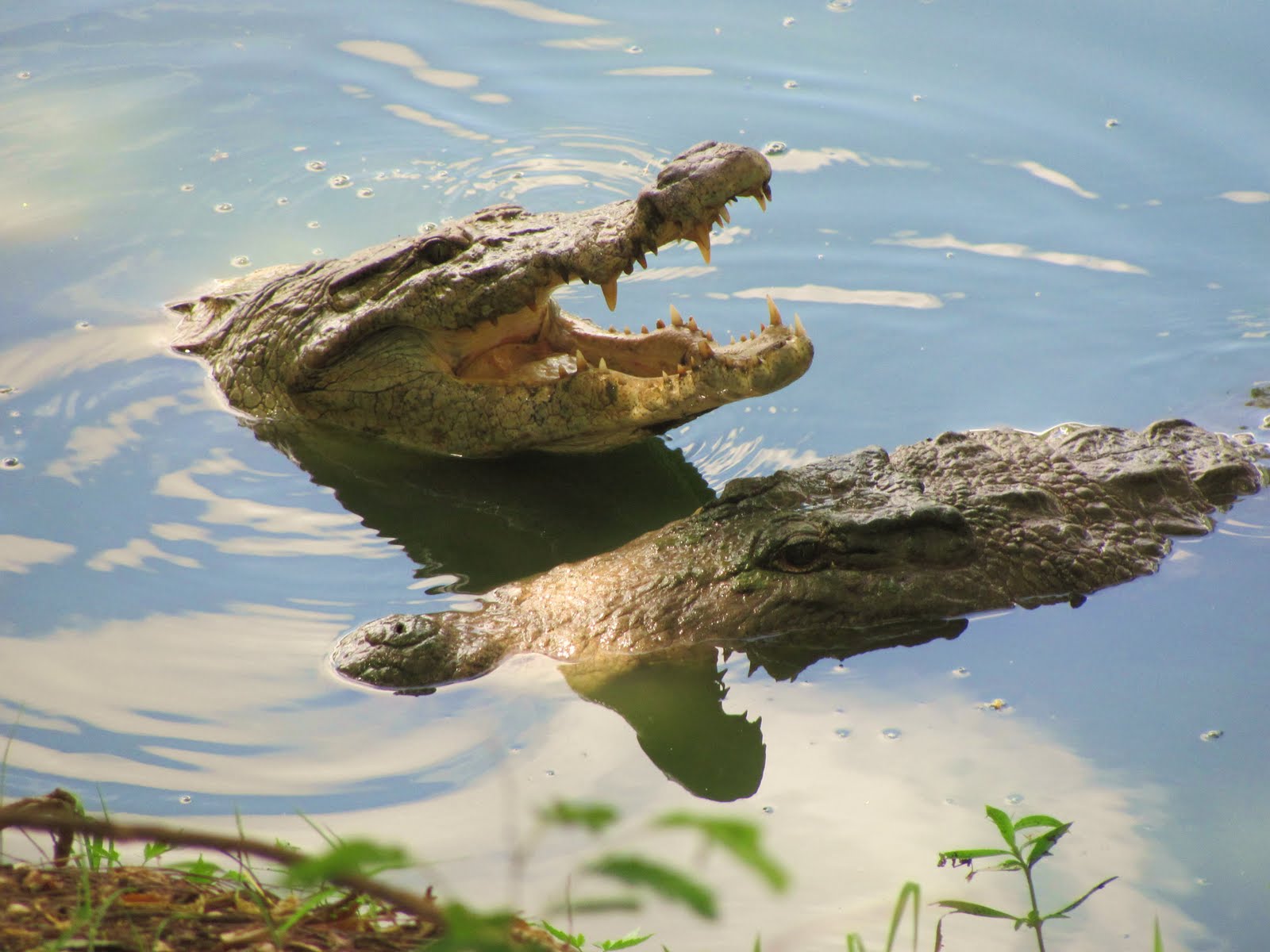
My National Geographic shot! :) Sometimes, you're in the right place at the right time. Upon arrival at the reserve, one croc stayed near the shore as we ate, I got some photos of him, but they were no big deal. His eyes and nose poked out of the water a bit, and sometimes he was only visible through the branches of the small trees between us. After a big lunch and a lazy afternoon, however, another croc came to call. Alerted by the growling or roaring of the second, I grabbed my camera and caught some action. As with all living photo subjects, the moment arrives, and then it's gone. Only minutes later, the second crocodile left the scene, and we had our peaceful, lazy afternoon back.

Wednesday, August 11, 2010

Sokone Dancing

Faces of Sokone


Visiting Sokone

Sokone is the home of one of our directors, Ousmane Sene. He is the current director of WARC, the West African Research Center. A dynamic personality, he is the patriarch of a large family, which we got to visit with on our way to Toubacouta. His beautiful house was the site of one of the best meals we ate while in Senegal. Below, Megan sits in the room which will soon be the site of meaningful camaraderie, serious eating, and listless chilling out after the meals have been consumed.
Notice the colorful cloth laid out for each small group that will gather around a common bowl. Strategically placed pitchers and bowls for hand-washing can be seen in this photo as well.
Diane uses a spoon at this meal. Not everyone did. Megan and I took the opportunity to use our hands. It feels like we're breaking all the rules we've grown up following. Jan prepares to take a photo in the background.
If you find yourself eating from a common bowl in Senegal, do not use your left hand. In an earlier post I told you why. Think of the meal as if it were a pizza. You may eat the wedge nearest you. If the portion of meat becomes unevenly distributed, it should be moved around in order to offer all people plenty to eat. Once you have finished, push the remaining rice and meat to the center. It's possible that a second group of people will sit around that same bowl once it has been removed from your group. Eating with your hands is expected, but utensils may be provided as well. Burping after the meal is considered a compliment. I couldn't bring myself to do that.
Ousmane's family has a beautiful, hexagonal kitchen which is separate from the house. Mosaic floors and hard surfaces are easy to clean. The kitchen staff was amused that we would want to take a picture of the kitchen prior to the meal.
After an initial greeting, and a special welcome from the children of the family and neighbors in the village, the women brought out giant gourds which would become drums. A celebration of music and dancing preceded our meal. This celebration started as a listening exercise, but soon, and one-at-a-time, the women would come to the middle of the circle and dance. By now, we'd come to understand that there would not be a dance celebration that we would be allowed to simply sit and watch. Eventually, every single one of us would be singled out to come to the middle of circle and try to put the moves on. Some of us managed passable dance moves, others of us managed to bring giggles to the locals more often than not. All of us gave it an honorable try.
The celebratory momentum picks up.
As I said, not one toubab tourist can escape the notice of the dancers. Kristine dances here.
Video:

Tuesday, August 10, 2010

Ile de Ngor Video

In the entry of 7/11/10 I tried to include a link to a short video that gives a feel for what it was like to be on the beach there. It didn't work in that format. Here is the embedded video.