Saturday, July 3, 2010

Boston - Day 3

Jennifer Yanco, The West African Research Association (WARA), U.S. Director. She has been a great source of information and has been very helpful in a multitude of ways.
Balla Kouyate. Look him up on YouTube. Several examples of his music can be found there.

The gourds on the underside of the balafon make the beautiful varieties of sounds. Balla says they must be replaced relatively often.
My roommate for this Boston portion of the trip, Therese Laux, is a percussionist. She gets a chance to play with Balla here. Note the ring on her finger. It is strategically worn to create the "clicking" sound.
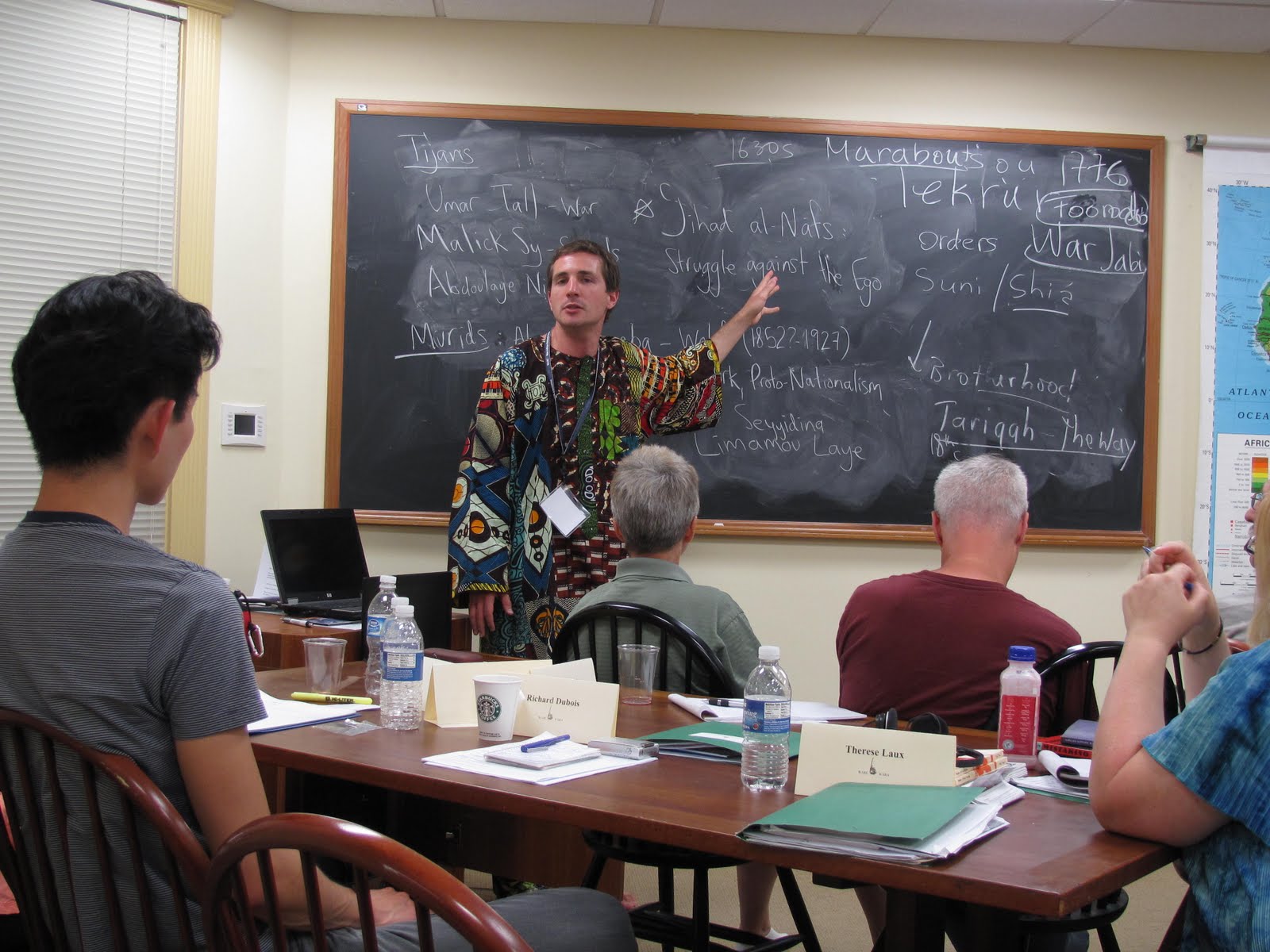
Alex Zito, above, teaches about the Islamic Brotherhoods in the Senegal region. Maase Ndiaye also expounded on the history of Islam in Africa.

Boston is getting a bit hotter. The humidity is climbing. However, by the time it becomes very uncomfortable, my Fulbright group will be in Dakar. Tomorrow morning we leave at 8 a.m. to begin another twenty or so hours of traveling, waiting, and traveling until we are in Dakar by 4:45 a.m. Monday the 5th. I can't imagine that I will have anything to tell you about regarding the day of travel, but one never knows for sure what events may come.

After viewing a film called Syntaxe Urbaine, by Arfang Saar, which is about the city of Dakar and is a historical and geographic overview, there were more Wolof lessons. I practiced bargaining with an imaginary taxi driver, asking where the bathroom is, and complementing the meal I have just eaten. Laurie and Steadman seem to be catching on very well. I worry about speaking Wolof, but may be able to code switch to a little French and English to get along. I'll take the handouts and my notes along on the plane to practice. I will also be completing some required reading tomorrow during our travel day. We then learned about the history of Dakar as an intellectual hub in the West African region. Samba Gadjigo, a professor of French at Mount Holyoke College, is like a walking encylopedia as he describes the chronology of the development of educational systems in Dakar. Sue (I did not learn her last name), who has lived in Africa for 33 years, shared social protocols with us. We, for example, will likely be eating some meals with our hands. We should NEVER use the left hand to eat when using a common bowl. Nor should we shake hands with the left hand UNLESS it is the last time we see the person. Why? Well, the left hand is thought to be used for very dirty business (IYKWIM!) If, however, it is the last time you will see someone, perhaps for a very long time, you shake hands the wrong way (left-handed), so that you must return to shake them the correct way. That completed, we moved on to an interesting performance. You may not have heard of Balla Kouyate, but perhaps you know the name Yo Yo Ma. Balla Kouyate is a balafon player and a griot from the Sundiata line. He has played with Yo Yo Ma and has also played at the Kennedy Center. It was an honor to see him perform today. An early afternoon break was followed by more Wolof lessons, and discussion about Islamic diversity and Brotherhoods in Senegal. A tasty Senegalese dinner including a dish called Ceebu Jen (rice, fish, ??) followed. If I were to get on that plane tomorrow, and it took me home instead of to Africa, I would feel that I have learned a great deal and had a very eventful seminar. To know that I still have four weeks ahead of me is extremely exciting. It's a little scary to leave the continent and the comfort of an English-speaking country, but I have waited for this day a very long time and am looking forward to it with great anticipation. Ba beneen. (Bye, bye)

Friday, July 2, 2010

Boston - Day 2

I can't figure out why I don't sleep until my alarm goes off anymore. This morning, after opening my eyes and taking a moment to figure out where exactly I was, I went out into the brisk morning and enjoyed a run (and walk) along the Charles River to begin my day. There were many college students and locals running and biking as well. The rowing classes or teams were out in great numbers as well. Beautiful!

Our meetings and lectures today included an overview of languages spoken on the continent of Africa, more Wolof lessons, a lecture about what it is like to be a foreigner in Senegal, and a viewing of a film entitled, Faat Kine. WARAs U.S. Director, Jennifer Yanco titled her overview of languages, "Do You Speak African?" She finds it is a common question asked of her and others who have lived or spent lots of time in Africa. The question demonstrates one aspect of Americans' misunderstanding of Africa because, in fact, there are more than 2,000 official languages spoken in Africa. Maas Ndiaye continued teaching us basic Wolof grammar and phrases. Today, focus was on parts of the body and what they do. For example, the eye sees and looks. Eye is "bet". See is "gis", and Look is "xool". Learning this may be one of my biggest challenges. Aye! Professor Patricia Tang told us about her experiences in Senegal as a foreigner. She is an ethnomusicologist at M.I.T. Additionally, she plays the violin and the sabar. (Remember the drumming group we saw on day one in Boston? The drums are called sabar.) Her anecdotes were very helpful and practical. Finally, we watched the Ousmane Sembene film called Faat Kine. He was the first African to make a movie about Africans. The movie's setting was Dakar and was in French with a little Wolof. Very interesting.

Boston is in the midst of a Harborfest. It is, after all, the Fourth of July week. We have seen the staging for the Boston Pops, costumed historical figures, and a faire at Faneuil Hall and the Quincy Market area of town.
If one is going to be in Boston, perhaps once in a lifetime, one must eat New England clam chowder in a bread bowl. One really must! Walking back from the Faneuil Hall to the hotel through Boston Commons was also a highlight.
This is the view of Fenway Park from my hotel room at Buckminster Hotel. There was a game tonight, but I decided that $35.00 was too much to pay for the cheap seats. Enjoying the cheering, the lights, and the hustle and bustle on the streets as ambiance was fine given my budget and the amount of time I have here.

Thursday, July 1, 2010

Boston - Day 1

In the evening after our meetings and dinner, Lamine Toure and his Senegalese drumming group played for us. Lamine taught us to sing (I know what you're thinking!!), clap, and dance. He told us stories of his grandmother and mother who are griots, or history keepers, storytellers, if you will. Lamine is in the red tunic. I will try to link a video here, but it's getting late (11:08 Boston time) and the video is still trying to upload. Perhaps tomorrow.


Whew! The travel day started yesterday at 5:00 p.m. Twenty-two hours later, I have arrived in Boston. You all know about airport layovers and lengthy plane rides, so no need to go into detail. I unpacked but ended up being late for my first meeting. Augh! I think it's rude when people are late, but I was the one who walked in after the program started this time. The desk clerk hadn't given me the note about the location of our meeting, so I went looking and found that I had to walk several blocks to the Boston University African Studies Center. I commit to never being late again during this entire month-long trip.

We began with introductions, which took awhile. We're all teachers, so if given a speaking forum... It was good, though, to hear what each teacher's background and goals are for this trip. In future posts, you will learn more about them as I do. We then learned some Wolof greetings. I can break it down to four for now:

"Salaamalekum" (literally - Peace to Allah - but kind of like "hello").
Respond, "Maalekum Salaam".

"Na nga def?" (How are you?)
Respond - "Maa ngi fi rek." (Fine)

Here's a bonus phrase. "Wow, wow" turns out to mean "Yes, of course." or you say it to encourage a dancer or a band. Practice, "Wow, wow."

We then went over logistics and had a wonderful Cuban dinner. It included chicken, plantains, rice with wonderful sauces, olives, and fruit. I don't know what each dish was called, but there wasn't anything that I didn't love. Following dinner, Lamine Toure, a Senegalese drummer, performed with his band. Check out his website, laminetoure.com. The drums each have their own names, but as a group you call them sabar. He says we'll see them a lot in Senegal. In modern times, they are played at celebrations because they produce a happy vibe. In the past, though, they were used as a communication tool. One group of people could send messages of eminent attack to another, or they may be used to encourage the troops. Today, in wrestling contests, each wrestler has his own rhythm played on the drums to "psych him up" for the contest. The contest may only last ten seconds, but the preliminary drumming could last an hour.
Check out this video of Lamine's workshop: http://www.youtube.com/watch?v=sugL93cIBpg

Guess what I can see right across the street and out my hotel window. Fenway Park!!! I'll be done with my itinerary tomorrow by around six. The game starts at 7:30. Hmmm.

Wednesday, June 30, 2010

I'm Off

Today is the day. My bags are almost packed. My reading is almost done. My excitement is almost contained. Only in the last day, have I begun to feel a little apprehension about whether I am prepared. Already this summer, I have traveled extensively. Each time I tried to remember a lesson about what I could do better next time. Take smaller bills and coins, for example, or take plenty of lotion and sunscreen. It doesn't do to run out on longer trips. I learned that it will be worth the weight of carrying my 15 inch laptop so that I can create documents as I prepare lessons, rather than deal with the slower and less equipped netbook. I will take a smaller bag for day trips so I don't have to lug my bigger backpack everywhere. Relying less on my cell phone has prepared me for international travel where I will not be able to use one. I know I could go and upgrade mine to get a global access card, but it will still be expensive, and I can simply use the internet, email, my blog, and Skype to stay in touch with my family and friends.

Why do most people say, when I tell them where I will be going, to "stay safe" and "be careful"? Yes. I have done some research on the area, the climate, the people, and culture of Senegal. I have read other traveler's blogs as well. For a first trip, I think I am as prepared as I can be, but I will learn, on this trip, things that I will do differently and better "next time". Since the likelyhood is that I will not be able to return to Senegal in my lifetime, I hope that what I learn can be useful to you or someone you know, who may have a similar opportunity in the future. I'm off this afternoon. By tomorrow I will be in Boston for three days of orientation and training. I do feel a little like I'm stepping off a cliff into the unknown, but I wouldn't change this chance of a lifetime for anything. I am taking that step. Come along via this blog. Share my adventure.

Tuesday, June 22, 2010

Podcast

The following link will take you to a 52 minute podcast in which the discussion tandems the book, Mistaking Africa: Curiosities and Inventions of the American Mind, by Curtis Keim. The book is required reading for the study tour on which I am about to embark. At 52 minutes, this podcast is not for casual followers, but for people who really do want to delve into American misconceptions about Africa. Perhaps you can start the podcast and listen while you fold laundry or sort your recycling. To the brave few - ENJOY!

http://www.wpr.org/hereonearth/archive_100520k.cfm

Wednesday, June 16, 2010

Why Are You Going to Africa?

One of the most frequent questions I get when I tell people I am going to Africa is, "Why? Is this a mission trip?" I explain that I will be studying several aspects of the West African country, Senegal, including culture, art, religion, history, government, geography, educational systems, and current issues. I say that my mission is to bring back what I learn to my students, my school, my district, and my community. The next thing friends want to know are the specific details of how the agenda will work, where I will be staying, etc. Happily, a recent communique from "headquarters"
introduces a website that thoroughly describes the project. Should you have any questions about "why" after browsing its various pages, I will be surprised.

I invite you to click on this url address to find out more about this project.

http://www.gs.howard.edu/wara2010/default.htm

Monday, May 17, 2010

Counting Down

I do not depart for orientation until the end of June. Thus, it would seem that I have plenty of time to continue my preparation for this seminar abroad. However, because I will not only travel to Africa, but also to Washington DC, Philadelphia, and New York with 8th graders, to Alabama on a Teaching American History grant to study the Civil Rights movement (see my blog, agrovesalabama.blogspot.com), and to Cabo San Lucas on a family vacation prior to the trip to Senegal this summer, precision planning must become my motto. Here's what's happening at this juncture:

All medical appointments are completed.
Yellow fever shot - check
Typhoid shot - check
Malaria pills picked up - check

More information has arrived from seminar directors, Mbye Cham and Samba Gadjigo. The new itinerary includes activity details for each day. Admittedly, I have read through this most exciting new material more than once, imagining myself at each event, meeting my colleagues, planning the curriculum focus for the project which I will present toward the end of the month in Senegal. I am a sponge. To learn as much as I can before I depart, I have done several things. I have ordered and watched "Globetrekker" DVDs about West Africa. I have ordered a "Traveler's French CD" course to review and add to what little French I remember from high school. French is the official language when doing business in Senegal. Wolof is also spoken. The orientation in Boston will include Wolof language lessons. There is pre-orientation reading to be done as well. My students would relate this to the summer reading required for some honors and AP classes as they move on to high school. These books include African History; A Very Short Introduction, and Mistaking Africa, Curiosities, and Inventions of the American Mind. There are also short videos that are accessed on You Tube which are recommended by our directors.

My traveling colleagues and I have begun to meet each other via a social website. Not all of us are using the site yet, but the comments and suggestions some have written have been heartening and helpful. It seems we are teachers from a variety of disciplines, which should be great fun.

No, I do not depart until the end of June, but am hoping that this documentation of pre-trip events and thoughts may be helpful to those considering applying for the Fulbright Hays Seminars Abroad, or a similar program. My students and their families are also on my heart as I write to include them in my experiences. While this experience will enrich my life, I feel a great responsibility to "pass it on". Do let me know if you have questions along the way. As my study tour unfolds, my commitment is to share this unique opportunity with you.