Saturday, July 10, 2010

Incredible Edibles

On the island of Ngor, lunch begins like this. On this particular Sunday (7-11-10), the Fulbright group was treated to a day on the beach. The island is very small. One could walk around it easily in about 30 to 40 minutes, depending on how often she stops to enjoy the view. One spectacle on the island is the fishing boats trolling in and out of the surf. The fishermen were kind enough to let me take a picture of the catch here. Some were spear fishing, others using boats and fishing lines; not rods and reels, but lines. The rebel fishermen were on the other side of the island fishing off the rocks. Does anyone know what kind of fish these are? This fish did not come from the catch in the photo at the top of this post, but it certainly looks more ready to eat Suzanne than the other way around. In the end, however, Suzanne reigned supreme as she made her way through le poisson.
Amy, Elana, Samba, and Ousmane wait for dinner at a wonderful restaurant. I'm not sure what culture one would consider that this meal originated from, although I detected curry, if that helps. This restaurant looks out over the ocean, and the breeze that night was cool and invigorating. See the dish below.
The bar at the Ethiopian Restaurant. Note that the bar and stool are covered with soda labels Waiting for our Ethiopian food.

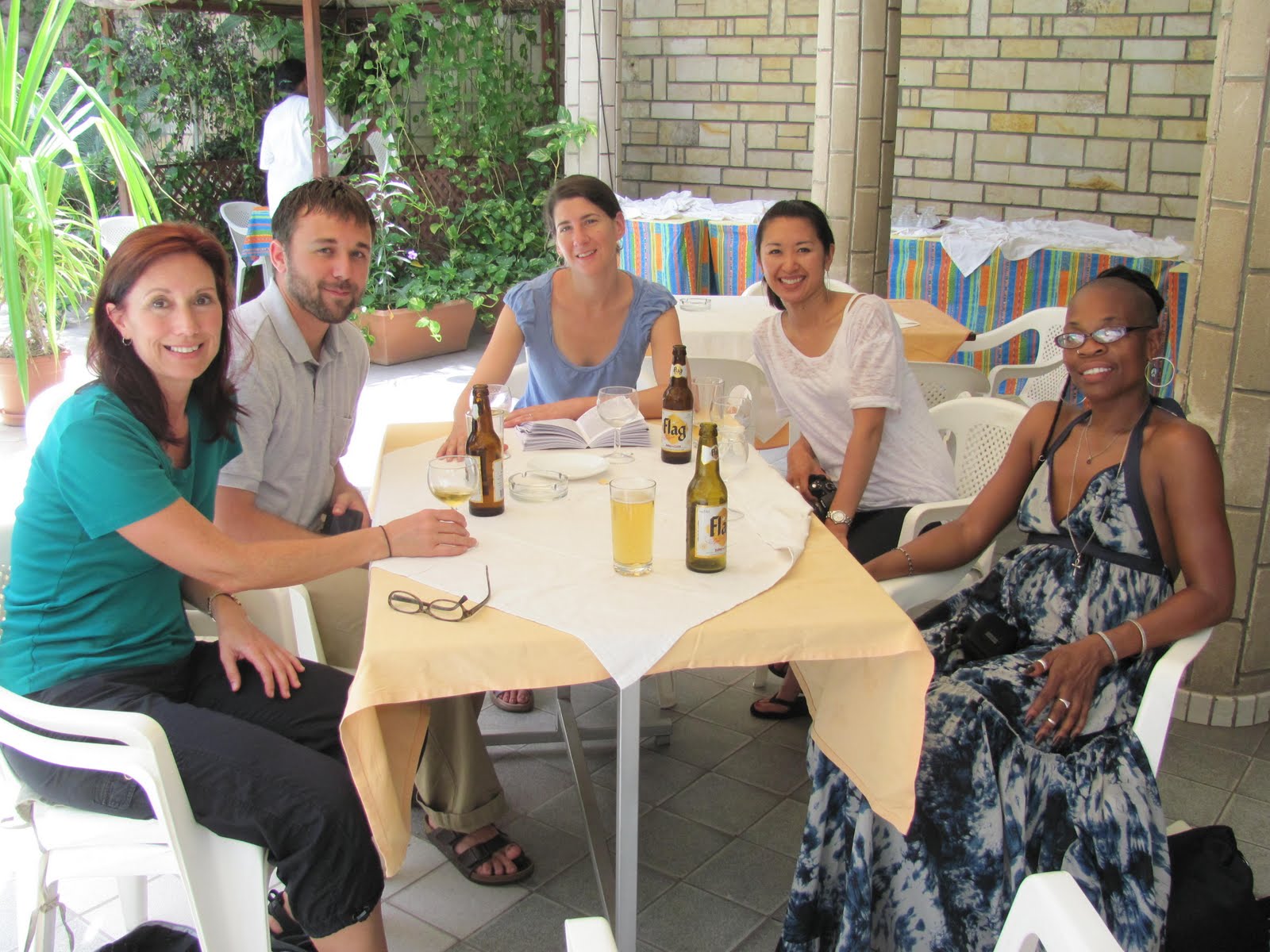
Can't eat another bite, but it was fantastic. Still the Ethiopian restaurant. Bill, Yumi, Steadman, Elana, and Jan.
When you eat with your hands, you REALLY need to wash up afterward.
At WARC, the cooks start lunch early in the morning. We have learned to check in on them in the detached kitchen to see what's on the menu. This day, it is Cheebu Jen, a Creole dish that's a favorite here. Because we have been so heartily welcomed, our various hosts have treated us to this regional favorite several times since we've been here.
Laurie talks to one of our cooks to find out some secrets of the recipe. I'm so thankful that Laurie speaks French. She has been extremely helpful as I've floundered with the little French I remember from high school. If any of my students are reading this, I want you to know that I regret cutting French class now. In my wildest dreams, I wouldn't have thought that my need for French would come during my visit to Africa. Hey students! All of your classes are important. You never know when you'll need to use a skill that you learned, or should have learned in school.


Lots of root vegetables are used in dishes here. Let's see... Looks like we have carrots, turnips, egg plant, and cabbage. (I was told the white roots are turnips. Is that true?)


Peppers for the Cheebu Jen


Chopping onions in the kitchen. These ladies were very nice about letting us invade their work space.


Snapper and garlic wait their turn to be included in the lunch preparation.
At this restaurant, we ate pizza. There were a multitude of specialty pizzas to choose from, and they were cooked in a wood-burning behive-type oven. The power went out a couple of times while we were there, so it's a good thing we had the light from the fire. This was a night that the mosquitoes came out to eat as well. Check out Teresa's pizza below.
John celebrated his something-ieth birthday here in Africa.

Samba said I should eat the mango with my hands. Again, I have a feeling he may have been playing a joke on me. He loves a laugh.
Me and Samba Gadjigo. This professor has a great sense of humor. His Holyoke College students must love his classes.
At the Village des Artistes, mangos cook under the leaves and in the stones.
Anyone can find instant Nescafe on the street without difficulty.
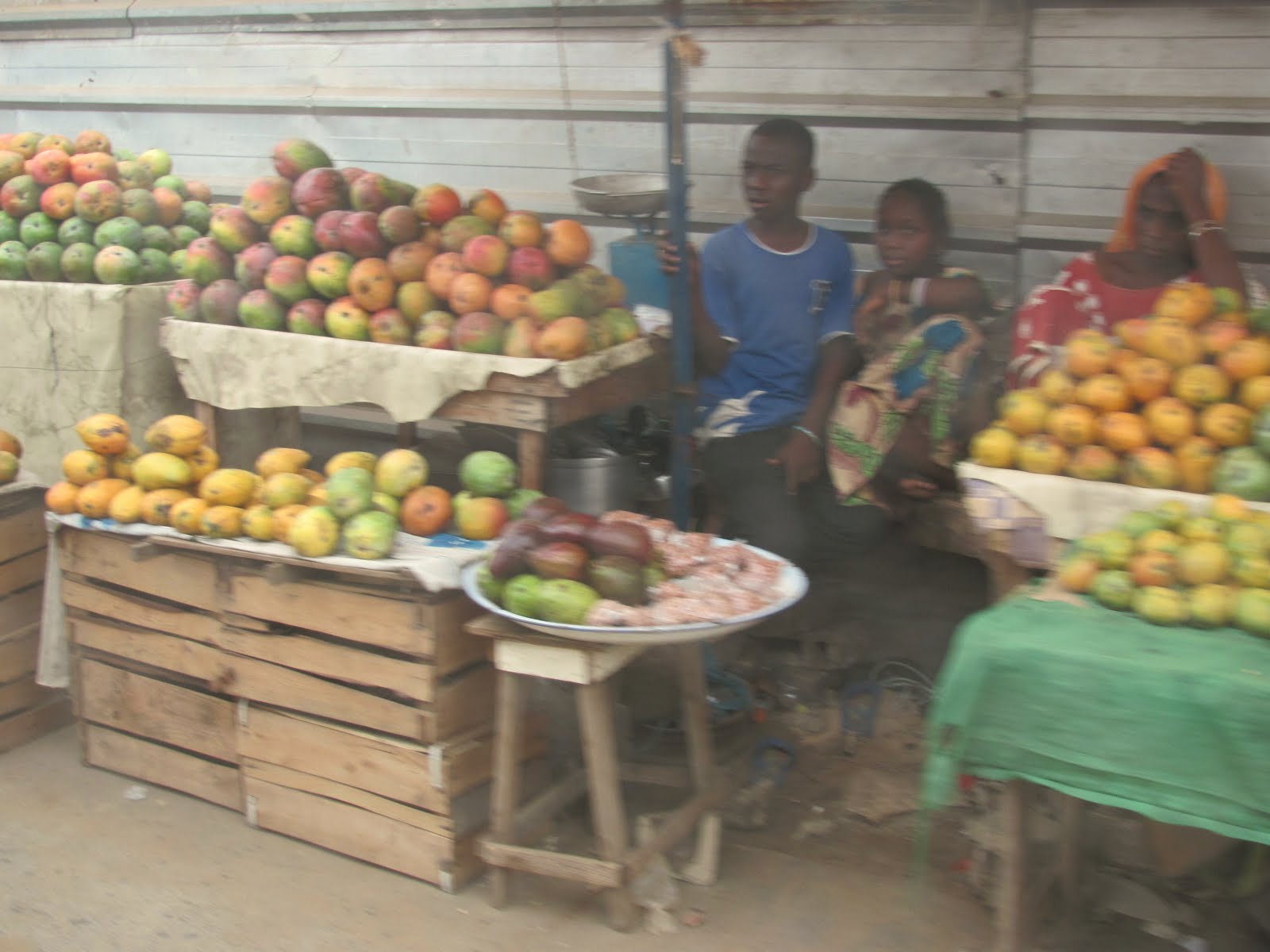
Photo taken from the bus. The mangos are especially sweet right now. If you come to Senegal, Laay says you must ask for Kent mangos.
More fruit
Millet.
The best couscous is made with millet, not broken rice. This picture was taken as I followed Jan into the kitchen of a highly regarded artist, who showed us his work and spoke of his inspiration. For those of you who would like to Google him, his name is Souley Mane Keita. I'll tell you more about him in a future post. This post is all about food. He laughed that Jan wanted to see his kitchen. She teaches home economics and is officially experiencing Africa through its food, while I am unofficially experiencing Africa through food.
This soda stand was on Goree Island. Sodas we are familiar with can be found most places.
The Goree Island restaurant we ate lunch at today (7-10-10) is called Doree Dolce Vita. Dan, you have to see the salad below! Wow, wow (Wolof for YES!). The flies were thick, so employees of the restaurant and our gracious and talented Mariane fanned them away until everyone had been served.

Corosso is made from prickly pear juice. It's sweet and creamy. I approve.
Presentation is key and well done here.
If Samba was playing a joke on me about how to eat the mango when it's cut like this, then I have done the same, because I had everyone else at the table eating these without utensils. Samba wasn't with us at this meal. No one could tell them any differently. Locals and restaurant employees did not laugh, so perhaps we were eating it correctly. :)

Thursday, July 8, 2010

Focus on Education

Professor Penda Mbow and Professor Samba Gadjigo
Professor Penda Mbow, Historian, was a dynamic speaker. She is an expert on Tradition, Religion, and Change in Senegalese society. She also spoke about the gender issue in Senegal. This was very enlightening. To adequately relay the information she shared would be difficult in this forum. African tradition and women's role in it, traditional Islamists, Brotherhoods, and the state are intricately entwined in a "chess game", if you will, as some work toward bettering the community, and others seek power for themselves.
This represents some of the classwork we are doing on this trip. Lectures, film reviews, and project planning keep the scholar in each of us busy. This group is great to travel with. They are positive and motivated. Each individual has strengths that enhance our discussions and project endeavors. More work on our projects will be done in the next few days. Our directors have been front-loading our knowledge banks so that when we see the sites, we will better understand the signifance of each one.

Teresa and Therese take notes as Ben Diogaye Beye, a pioneer of Senegalese cinema speaks about his documentary, Dakar: La Rue Publique.
We work, daily, at the West African Research Center, http://www.warc-croa.org/ . This is the mosaic on the walk as you enter the compound.
One this day, 7-6-10, we toured the local colleges. When I say local, remember that Dakar is the capital of Senegal, and the colleges here are very prestigious. We passed by the Universite Chiekh Anta Diop, which is where the Director of WARC, Ousmane Sene, teaches African Literature and is chairman of the English department, on our way to CODESRIA (Council for the Development of Social Science Research in Africa). We were informed about the mission of the school and the programs it facilitates. http://www.codesria.org/ Basically, CODESRIA facilitates research, promotes research-based publications, and creates multiple forums for exchange of views. Classes are super-crowded, so competition is stiff. There simply aren't enough schools at any level to accomodate the great numbers of students who wish to continue their education. There is never enough of anything in this developing country. These are not my own words but the words of our speakers during the informational round-table. Samba Gadjigo describes the system as an upside-down funnel. Many students can enter school at the kindergarten and primary levels (widest part of the funnel), although this schooling my take the form of private Qur'anic study until the age of five, which is not state controlled.
DIGRESSION WARNING! - The young, mostly boys one sees begging on the streets are often part of a group of "school" boys studying under a marabout, or religious teacher, who sends them out after morning prayers and study to beg or sell goods for money. The money is turned over to the marabout for his support. The parents of the boy have "given" him to this teacher for a pre-determined period of time. He may, then, return to his family, where he might or might not have the opportunity to attend public school. Private schools are very expensive.
BACK ON TOPIC - Over time in a child's life, depending on his family's economic, and sometimes class, situation, it is more likely that his education will be interrupted by a variety of more basic priorities. Thus, the young people who complete higher education may "pop" out of the narrow top of the upside-down funnel Professor Gadjigo describes. As you surmise, the educational system needs both help and independence from the state government. There are several political issues that affect the school system. I hope to describe my better understanding of the political and religious current issues in a future post.
Sue listens to Ousmane Sene as he expounds on the educational systems providing higher learning for Africans. On the far right is Dr. Ebrima Sall, Executive Secretary. Regretfully, I did not write down the names of the two panel members in the middle. My apologies.

Wednesday, July 7, 2010

The African Renaissance Monument

A view from the hill upon which the monument sits. There are 195 steps to climb to stand at the foot of the bronze.
I took this picture so that you could get an idea about the scale of the monument. Note the size of the onlookers and the foot of the monument.
Many Senegalese do not appreciate this monument. The man, woman, and child looking and pointing toward the west represents the Renaissance, or rebirth of Africa after the slave trade. The president, Abdoulaye Wade, commissioned this monument as a celebration of the 50th anniversary of independence from French colonial rule and a message of hope to the youth of the country. It was designed by a Senegalese, Pierre Goudiaby, but produced by a North Korean company. Here is what I understand about the reason most local people groan at the sight of this statue. To begin with, since Senegal is 95% Muslim, one should call this a monument rather than a statue because the Muslim religion does not make images in human form in their art. The expense was enormous, 27 million U.S. dollars. The complication is that the people of West Africa see challenges all over their cities including poverty and the need for a better infrastructure. How does the government justify, they ask, the expense of building this monument when there is such great need at more basic levels? Also, as noted, this country is mostly Muslim. The statue's (I mean monument's) design shows the woman with part of her body exposed, it is in a Stalinist style, and the bodies do not look like Africans. Abdoulaye Wade said, "It brings to life our common destiny. Africa has arrived in the 21st century standing tall and more ready than ever to take destiny into its hands." So there it is.
Mame Coumba Ndoye, left, chats with a vendor at the street near the African Renaissance Monument. Mame Coumba is assistant to the Dakar coordinator of our Fulbright program. She is also the administrative assistant to the Director of West African Research Center (WARC).

The Lighthouse

Les Mamelles Lighthouse was built in 1864. It sits on top of a hill in Dakar. The view of the city from this hill is amazing. Bill and Kristine are getting photos of the lighthouse before heading back to the bus.
There are some very beautiful and colorful blooms on some of the trees and bushes here. They must love the heat and humidity.
Beyond me in this photo is the western-most point of the African continent. The thought that I'm looking back toward America from West Africa is incredible. As a history teacher, the significance of the slave trade routes from here is quite emotional. Later in our seminar, we will visit Goree Island, which is one of the places slaves were held and then loaded onto ships headed for the Americas and the Indies.
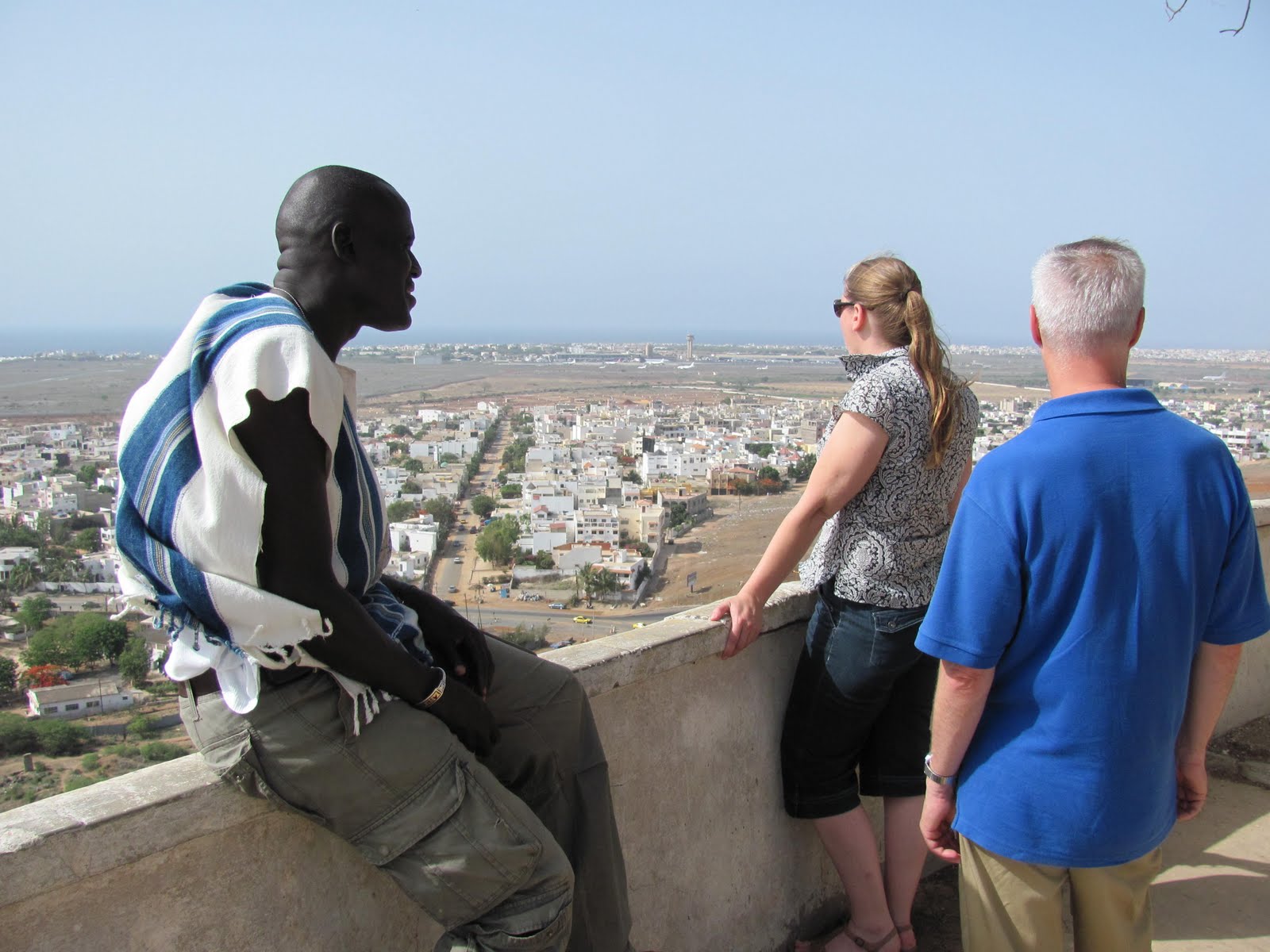
Our guide, Laay (sp.?) discusses the city and geographic points of interest with Teresa and Richard. I believe the airport is visible in the background of this photo.

Don't miss the video url address in the previous post!
The sights seen during our bus tour on July 5th include today's post and, perhaps, future posts. We saw many interesting sites.

Monday, July 5, 2010

Touch Down on the Continent

A view from my room. I am on the third floor of six in this hotel. This picture was taken very early in the morning, perhaps 7:00 a.m. Later in the day, the street is bustling with vendors. Bustling! My room is simple, but clean. The doorknobs and lights operate differently than the ones at home. There is wireless internet here, but the electricity is not dependable. We have occasional "brown outs" in which most of the town's (the hotel employee said all of Senegal's) power is out. They must have emergency generators which keep the essential lights on, but no outlets, TV, or air-conditioning works when the power is out. Currently, the power is out. There has been a life-saving breeze blowing today (7-6-10).My dinner on Monday evening was very good. Language translation was a little tricky, but I believe the waiter said this fish is perch. A dichotomy seems to exist between abundance and want. We have been fed very well here. Too well. I simply cannot eat all that I am served. At the same time, I am increasingly aware of the need to conserve other things. Toilet paper is sparingly provided, and in many cases already, I have found the need to bring it with me because some facilities do not provide it. There is evidence of want on the streets, in some areas of the city more than others. Like any city, I suppose. I've heard differing figures, but around 50% seems to be the average number to describe unemployment here. When rural, agricultural lifestyles are no longer productive, Senegalese do what anyone else would do. They move to the city to find work. With the crowded conditions and the weak infrastructure, including city public works and housing, Dakar strains under the pressure but is working on this problem. It is also a land-locked city, meaning there is only one way in, and one way out of the city. Traffic is unpredicatable, especially if it rains. The rain does not drain well, which limits where one can drive.
After lunch on Monday, I enjoy visiting with my new friends. It is still hot, but a breeze has begun to move the air around, so it becomes pleasant. This is me with Steadman from Kansas, Suzanne from California, Yumi from California, and Elana from Washington D.C.
This is one mode of transportation for people or goods. However, cars, busses, and taxis crowd the streets as well. In fact, it took us about two hours to drive through the market streets to get to WARC today (7-5-10). Some unusally busy streets held us up. It should have taken only a few minutes to get there. That, however, gave us a very good opportunity to see the market.
Books for sale at the local market. A market scene from the bus tour of Dakar. Taking us on a bus tour was a good way to give us an overview of the city. Some parts are nicer and have newer buildings. Others are very busy. People everywhere are selling goods. It reminds me of New York city streets where there are street vendors and tiny stalls which contain goods for sale. This, market, however, was ten times more crowded with makeshift storefronts and had far more people trying to sell their wares without even a place to display them. There is construction going on in most parts of the city, but some of it looks as though it's been abandoned for a very long time. Trash is also common in the market streets that I have seen. I'm told that there is a trash pick up service, but they pick up only what is in the small cans, and people don't feel the need to use the trash cans when they are ready to pitch their waste. I saw this happen at the airport upon arrival to Dakar. The research center is located in a quieter, government business part of town. I hope to get lots of good work done there.


* Check out this short video of a drive down a Dakar highway.
http://www.youtube.com/watch?v=6D1Mf4kNU1c


A reception was held for us this evening. It featured dinner, meeting our new friends from the WARC, or the West African Research Center, a couple of bands, and dancing. We were very tired, but everyone participated in the dancing as well as the eating.
Parotille played for our reception on the first evening we were here. They began with familiar American songs and artists like George Benson and Carlos Santana. I'm pretty sure my George Benson album is still in my closet. They then moved to Senegalese rap. Theirs was on the milder side of the genre. Rap in Senegal is used as a tool to send messages of peace, family responsibility, protest against corrupt government, and love. I have to take their word for it because I understand very few of the lyrics. Fou Nalade followed with more rap, and then Parotille finished the evening music performance. We will be seeing musical performances many more times, both scheduled on our itinerary and optional opportunities. Senegal is widely known for its distinct music. Watch for more information on the music called Mbalax.