Sunday, July 11, 2010

More on Education

Yelimane Fall, painter, has a center in Pikine. He spoke about language, culture, and the spiritual lives of West Africans. Additionally, he runs a center for the arts in which his studio is located, along with spaces for several other artists of all genres, even clothing design and music. He also does NGO (non-governamental organization) work in the community. Pikine is about 30 miles from Dakar.
Fall shows us a short video of the process he uses to create his calligraphic art.
Ndeye Ngiaye Tyson and Fall showed us a center that takes in street children. They asked us not to photograph the them. The staff actively searches the streets for young children who appear to have no home or family, and brings them to the center for education, food, shelter, and structure. They also create files for each child and search for the families to reunite them if possible. Here Fall and Tyson are speaking to us about the center, about Tyson's work with the community, and about her role of wrestling promoter. That's right! The name Tyson is her professional name. We go to see a wrestling match, Senegalese-style, tonight. This is a spectacle not to be missed! Tyson is the first female wrestling promoter, which is only part of the reason she is adored by people in the communities she has adopted. When driving and walking through a local village (more to come about our life-changing experience at this village), graffiti testifies to how much people esteem her. She gives them hope for a better future.
The classroom at Village Pilote
Books in the classroom are in French. Because these children appear not to be in school, I expect that they cannot access the stories, except through the illustrations, unless the books are read aloud.
Children of the streets of Senegal, act together! (I think - Remember my French is rudimentary.)

SABS
A Visit to a private school was interesting and informative.
Elana checks out the literature and textbooks on the shelves in the presentation room. While the books are copied and spiral bound here, Stephanie Nails Kane, principal, says that they are being replaced with electronic textbooks and CD's. They do have hardbound books, but shipping costs can be quite high, so SABS is working with online resources often.
The founder and principal of the school, Stephanie Nails Kane, is from Baltimore. She began as a parent who was interested in improving the education of her own children. Encouraged by others, she organized the school, beginning with pre-school and kindergarten-aged children only. Each year a new grade level was added. In addition to classes, students have opportunities to meet with one another in peer study groups, use computers to do research and projects, and get individual help. Kane says she believes the difference between public schools run in the French tradition and her school is that SABS looks at the learning styles of individual students and addresses them. She also says that the school does not have stringent entrance requirements, so anyone may take advantage of the unique opportunities offered here.
In this private school, SABS, students get to work in smaller classes than in public school. While school was already concluded for the year, these students were on hand and agreed to speak to us about their experience in SABS. All of them are ambitious and have either already gotten scholarships to universities in the U.S. and Canada, or they are working to that end. They all plan to return to Senegal after graduating the university, in order to be a part of improving Senegalese society.
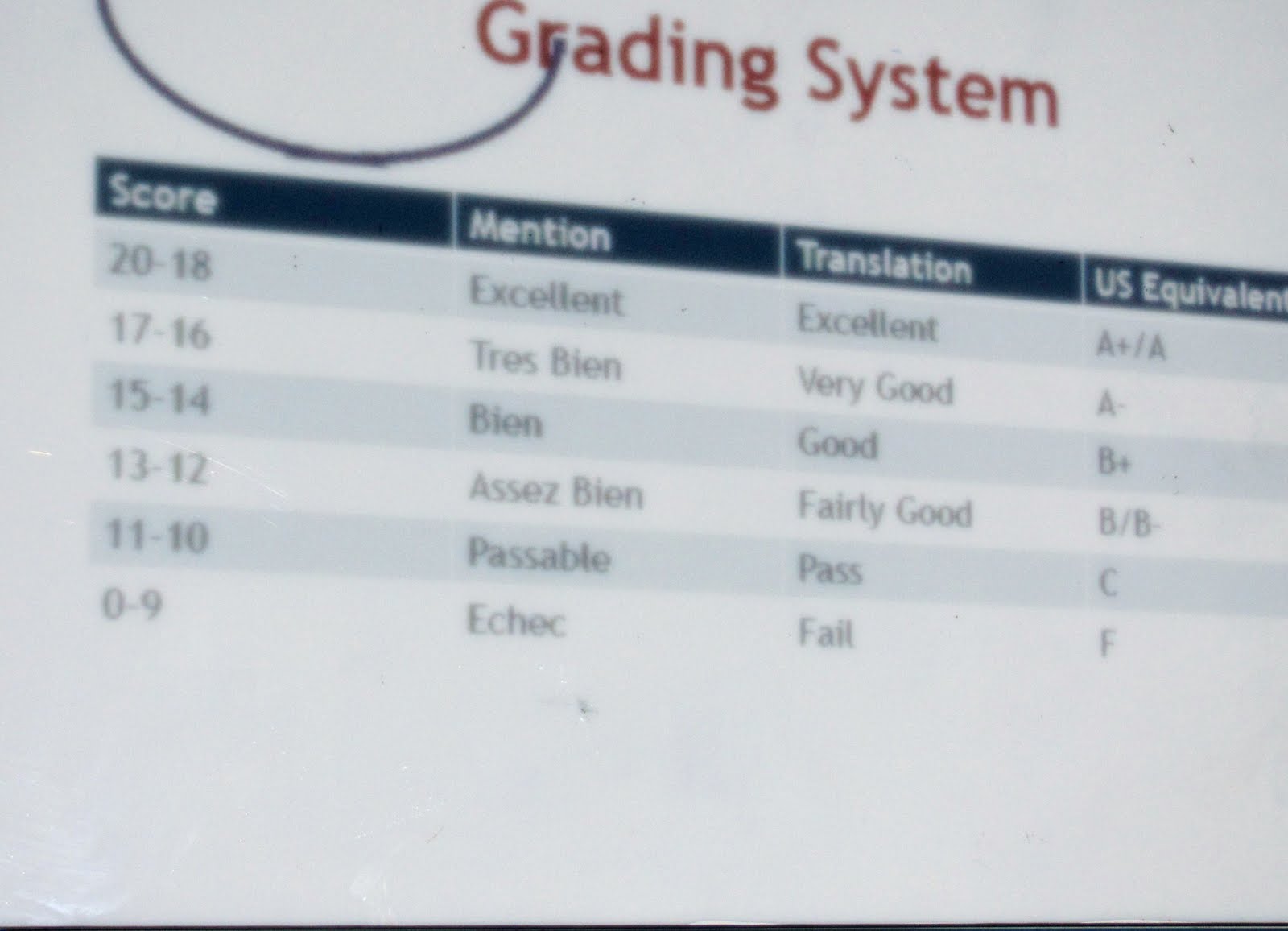
The grading scale for public schools in the French tradition is pictured above. It is common that students do not acheive higher than a B+. That is considered good.

Ile de Ngor

Our group suits up for the boat ride out to the island of Ngor. When asked about the historical significance of the island, the answer was that it was a fishing village. We enjoy a day of exploration, good food, watching the fishing boats come in and out, and checking out the wares of the vendors. As the day wore on, more and more boats full of people arrived. This was the most crowded beach I have ever been on.
In order to make sure we had the chance to buy from her, this vendor followed us all over the island as we took our tour. The island is very small. The perimeter can be walked in under an hour . The far side of the island is not so "touristy". Very peaceful, as a matter of fact. Some of our group stayed to soak up the sun while others walked to see the sights. This is Akon's island home. Seriously! He wasn't there, of course, but they say he visits often. For those you aren't sure who Akon is, a quick google or youtube search should help.Scenes from the Ile de Ngor

Which ones do you like?
The end of a very warm, very relaxing day.
Video alert!
To hear and see what it is like to be here on a crowded Sunday, see the video embedded in the blog of 8/10/10.

Goree Island and the House of Slaves

http://edition.cnn.com/2012/02/21/world/africa/goree-island-senegal/index.html?hpt=wo_mid

The CNN video above describes the Maison des Esclaves and its history.

From the ferry between Dakar and Goree Island, many fishermen and their beautiful boats could be seen at work. As the ferry draws nearer the island, French colonial buildings come into sharper view.
Young boys swim out to meet the ferry.
Along the walking paths, crafts, art, and other wares are for sale. Everything is so very colorful here. Our guide described how, at the end of French rule on the island of Goree, the stationary guns were turned toward the island instead of facing out to sea (guarding against Hitler's advances). No one knows why they were turned toward the island, but they were also destroyed by cutting notches out of the barrel, as you see in the photo below.


If you look really carefully and intently, you will see the Statue of Liberty way out there.
(KIDDING!!)

Mame Coumba and Elana look at some sculptures.


The building known as the House of Slaves was built by the Dutch in 1776. It was the last slave house built. The first ones were built by the Portugese, the first Europeans to arrive at the island in 1444. This was the place where Africans were brought after being rounded up for deportation to the New World. Much of the New World was built by and with the economic resource of slaves.
A visitor to the House of Slaves gazes out on the ocean as he looks through the "door of no return" through which slaves walked as they were loaded onto ships.

A hallway down which slaves passed on their way to the slavers' ships.

Holding "houses" held either men or women, who were released once a day to take care of their personal needs. 100 - 150 people were kept in each room, I mean house. The filth created by the waste was the cause of a pest epidemic which devastated the island in 1779.
An opening from a holding room in the House of Slaves looks out onto the Atlantic Ocean, across which around 50 million slaves were sent to the Indies, the Americas, or Europe.

The sign above the door tells us that recalcitrants, or slaves who were misbehaving, were put into this tiny, dark, dank room as punishment. Families were housed separately, and likely never saw each other again. Men had to be at least 60 kilos, and if they weren't, they were set aside to be fattened. Women who were virgins were highly valued. Some slave traders had children with them. In this case, the women could be released and their mixed race daughters were called segnors, which comes from the Portugese noun, "segnora".
These are the famous stairs of the House of Slaves.
This is the line to return to the mainland on the ferry. We stood in line for around an hour and learned a lot in that time. The concept of single file and any personal space does not occur to people here. There is constant pushing and passing in order to get closer to the front of the line. A grandfather sat on an overturned bucket and cared for a young one of about a year old. His patience was impressive. Another young boy "tossed his cookies" nearby.
An elementary-aged group of students (I presume they were students because of the blue vests.) rode the ferry to and from the island with us. These girls thought it was pretty funny that my French stinks. We had a fairly rudamentary conversation with pregnant pauses regularly. They did like my camera and asked to have their picture taken.

Village de Artistes

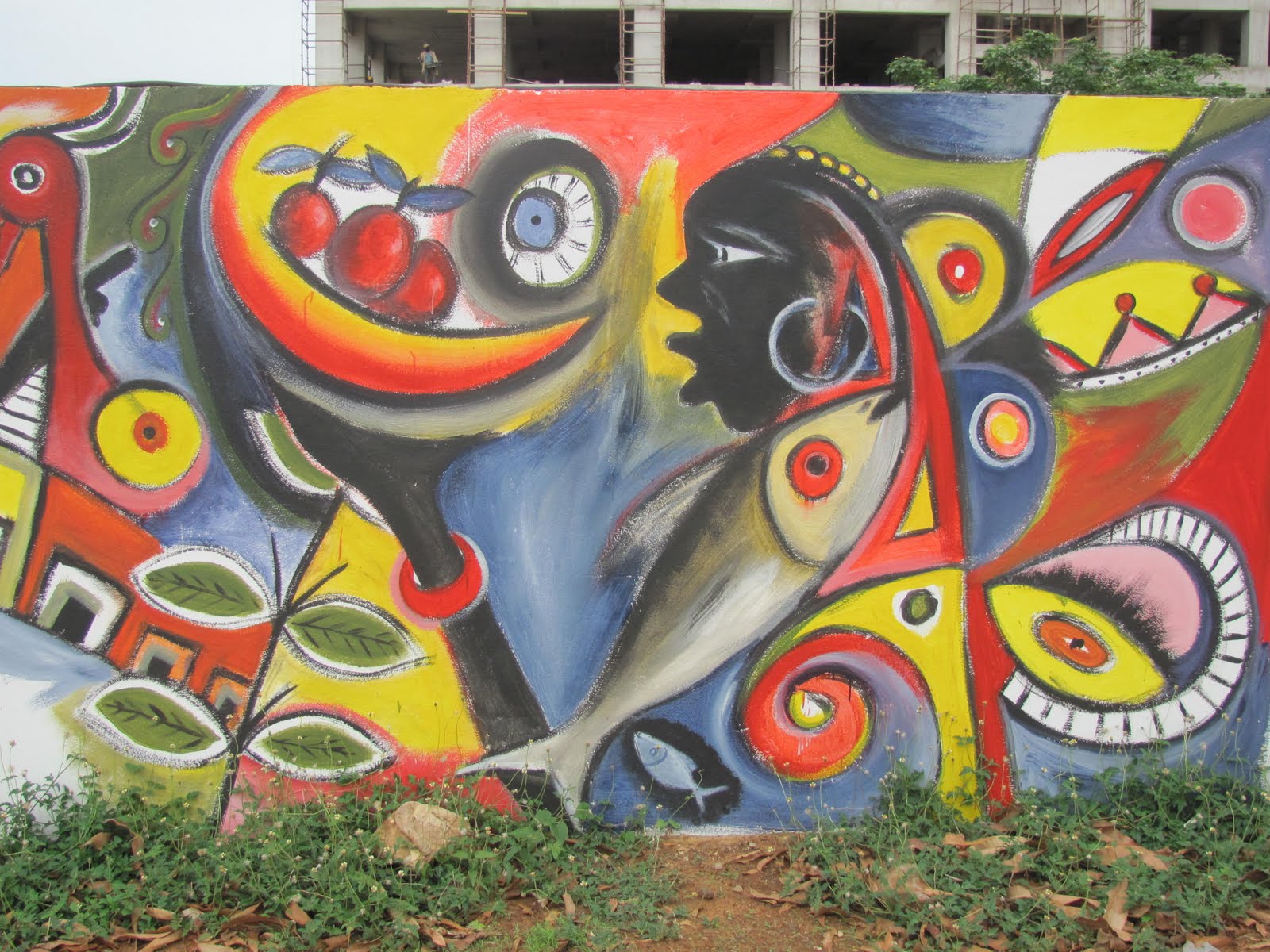
Wall art at Le Village de Artists greets our group as we visit on July 9th. I know, I am a couple of days behind as I post and journal about my study tour of Senegal. I've found that this blog has turned into thematically, or topically posted ponderings. Which means that you may go back and reread a post and find that there is more information or a link to a video or resource. Our days are full, so time to catch up here is limited. Enjoy the photos of art in this post. We did not spend much time here, but some of us will be going back to this village to interview some of the artists for our curriculum projects . Remember, they speak mostly French and Wolof, so interpreters are needed in most cases.

Wearing an Obama shirt, this artist displays his batik work. Even the building were works of art. Mbye Cham exits this studio.
Laurie interprets the artist's statement about his work and inspiration.
I asked if the painter of this work was inspired by Picasso. He said he had heard of him, but the inspiration for many of his works is African masks.
Suzanne enjoys this opportunity to visit several artists' studios.
More wall art. This wall is located at Le Village de Artistes, but there is art all over the city of Dakar and into the suburbs. Watch for more photos in future blogs.

Speakers and Specialists

Can rap music possibly be considered oral history? On Monday, 7-12-10, after an informative morning lecture given by Mr. Lamine Kane about the Senegalese educational system (which I will elaborate on in a later post), we heard from three significant personalities about Contemporary Youth Culture and Practices in Senegal. That is to say that these folks are in the creative arts, have been for some time, and can comment on what they are seeing with regard to similarities to traditional customs and whether or not any positive changes are coming. Above is Fatou Kande Senghor, a film maker and photographer from Nigeria. She has worked with the hip hop community since she was young. Her interests are in the shifts in youth culture at different ages and she has done research that concludes that hip hop isn't anything new. It's been around since the days of traditional and indiginous cultural practices. Senghor visited a village in the south and found similar rhythms, vibrations, and energy in the rites of passage gatherings. She has documented, on video, many hours of hip hop performed by various groups and makes the assertion that hip hop and traditional practices are related.
Duggy Tee (The power has just gone out again. This doesn't surprise me anymore. It happens a couple of times a day on average.) Anyway, Duggy Tee of Positive Black Soul (I think), or PBS spoke to us as well. Since 1989, he has been rapping, but his evolution is interesting. At first he just admired other rappers and wanted to be like them. Friends told him he had the talent to step up and start his own group. He then decided that he was different than many rap groups because he wanted to have a positive message, AND he wanted to stay in Senegal. His songs focus on the health, security, education, and similar themes. You can look him up on You Tube. What I like about his rap, besides the lyrics, is that he actually breaks into melody and sings as well as raps. Duggy Tee raps in English, Wolof, and French. A short video clip can be seen here.
http://www.youtube.com/watch?v=3djfucgkvXo

Fou Malade has been rapping since 1996. He also uses positive messages as lyrics. He started rapping as a way to speak out. Malade grew up thinking that young people didn't have a voice. He saw rap as the only way to speak out on important issues. He works with prisoners and former prisoners to help them become productive and resonsible through rap.
Souley Mane Keita allowed us into his home and studio to show us his artwork and describe what he draws inspiration from as he continues his long and successful career. Note the blue art piece that he describes as "baggy pants". Fulani men, he says, wear baggy pants and carry a pole which they place their arms over. (So sorry, I can't remember why...)
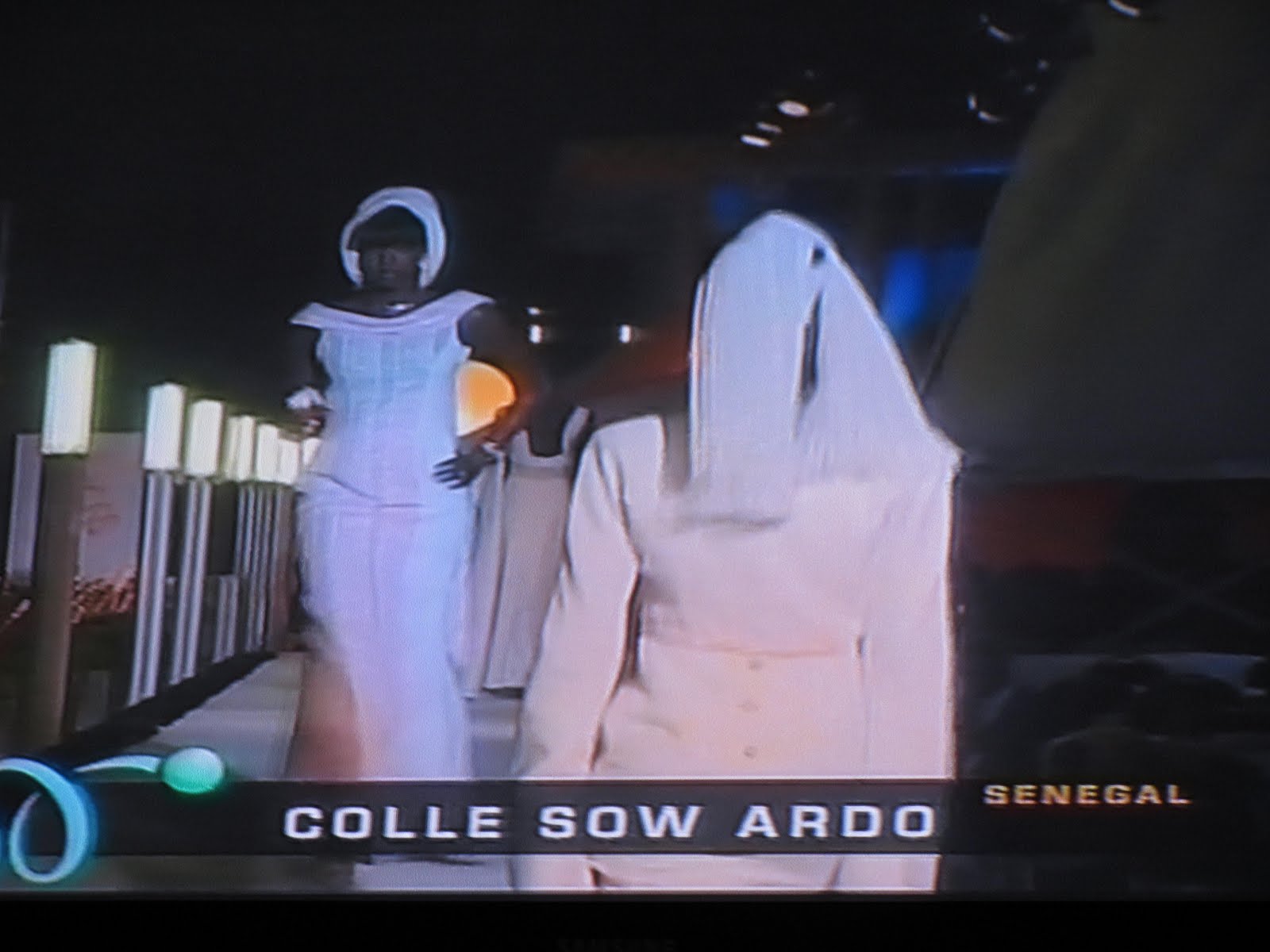
Colle Sow Ardo has been a Senegalese fashion designer long enough that she has seen the marginalization of African designers in national clothing shows. That, however, is changing slowly. See her website at collesowardo.com.
This scene from a video highlights a couple of pieces from Colle Sow Ardo's collection. Penda Mbow, you can tell by this photo, is a dynamic and animated speaker. She is a historian and an expert on gender issues, political reform, and the social structure of African cultures. She lectured twice this day (7-8-10). The first lecture cited many struggles that are facing Senegalese people. Women were important in folk tales and the social structure before outside influences arrived. the French, Portugese, Europeans, and Americans brought a patriarchal society. Islamization also brought a shift in the place of women in society. Lecture number two focused on the things that give her and others hope for a good future for Senegal. As I said in an earlier post, West African issues cannot be addressed in categories. Religion, politics, the economy, geography, and the movement of people from rural areas to the city are complicated and intertwined. Mbow is up to the, very likely, long road ahead as she speaks out for reform in Senegal.